-
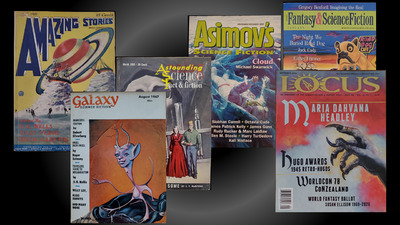 Science Fiction Magazines
 Science Fiction magazines appeared in the 1920s. Some came and went, some changed titles, editors, and/or publishers, and the rest hung on by a thread.
Rare Books and Special Collections holds many of the titles published throughout the ten decades.
Items are part of the SFWA Collection
*Amazing Stories - Vol. 1 No. 1 (April 1926) {PS648.S3 A5a}
*Galaxy Science Fiction Vol. 25 No. 6 (August 1967) {PS648.S3 G332a}
*Analog Astounding Science Fact & Fiction - Vol. 65 No. 1 ( March 1960) {PS648.S3 A77a}
*Asimov's Science Fiction - Vol. 43 No. 11/12 (Nov./Dec. 2019) {PS648.S3 I8a}
*The Magazine of Fantasy & Science Fiction - Vol. 84 No. 1 (January 1993) {AP2 .M2344}
*Locus Vol. 85 No. 3 (September 2020) {PN3433 .L63a}
-
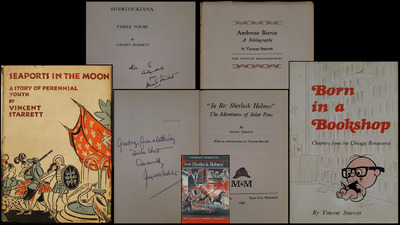 Vincent Starrett Collection
 Vincent Starrett (1886-1974) was a book collector, author, bibliographer, and a Sherlock Holmes scholar. He has been referred to as part of Chicago's "literary renaissance.” It has been said that Starrett's bibliographies on authors such as Arthur Machen, Stephen Crane, Robert Louis Stevenson, and Ambrose Bierce revived their popularity.
He was a crime reporter, feature writer, political analyst, and foreign correspondent for the Chicago Daily News until his first novel, Seaports in the Moon (1928) was published. He also wrote a weekly column called "Books Alive" in the Chicago Tribune for 25 years, influencing the reading habits of millions.
One of his greatest claims to fame was his fascination with and knowledge of Sir Arthur Conan Doyle's Sherlock Holmes.
(https://archives.lib.niu.edu/repositories/2/resources/844)
Items are located in the Vincent Starrett Collection
* Seaports in the Moon: a fantasia on romantic themes. by Vincent Starrett. {PS3537.T246 S41928}
*Ambrose Bierce: A Bibliography. by Vincent Starrett. {PS1097.Z5 S725}
*"In re: Sherlock Holmes"; Adventures of Solar Pons. by August Derleth (signed); forward by Vincent Starrett. {PS3507.E69 I5}
*Sherlockiana Vol. 1: Three Poems. by Vincent Starrett. (signed) {PR4624 .B547 1934a}
*Born in a Bookshop: Chapters from the Chicago Renascence. by Vincet Starrett. {PS3537.T246 Z5}
-
 The Tattoo Dictionary : an A-Z guide to choosing your tattoo
 The Tattoo Collection is the newest collection in Rare Books and Special Collections
Located in the Tattoo Collection {GT2345 .A395 2016a}
-
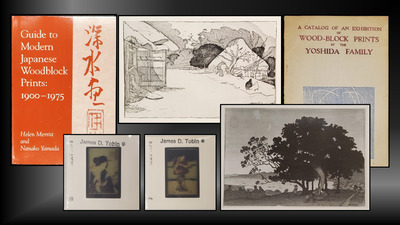 Tobin Collection
 The James D. Tobin Collection consists of materials on Japanese woodblock prints from about 1890, particularly print artists of the late Meiji, Taisho, and Showa periods. Included in this collection are rare exhibition catalogs and brochures, extensive research notes, photographs, books about prints, correspondence, and conference recordings.
Items are located in the Tobin Collection
*Guide to Modern Japanese Woodblock Prints: 1900-1975. {NE1323 .M461992A}
*Farmhouse" (1926) - Contemporary Japanese Wood-block Prints Vol. 3 1952-1984 {NE59.7.T62 C646 1952a}
*A Catalog of an Exhibition of Wood-block Prints of the Yoshida Family. {NE1325.Y6 C373 1953a}
*Colour Print Collection: 35 mm colour slides for talks re the history of wood-block prints in Japan. {NE59.7.T62 C656 1971a}
*[Drawings and papers] of Charles Bartlett. Wood-engraving "Isogo" {NE1112.B38 B3741915A}
-
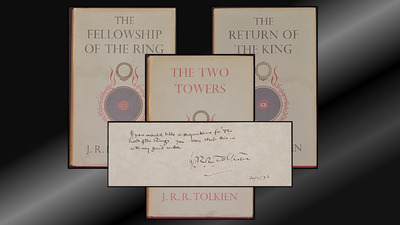 Lord of the Rings
 Pt. 1. The fellowship of the ring.
Pt. 2. The two towers.
Pt. 3. The return of the king.
Printed in 1963, this is the 13th impression of J.R.R. Tolkien's 1954 edition. It was purchased for the Library's 2 millionth volume celebration as part of the Science Fiction and Fantasy Writers of America (SFWA) Collection.
Located in the Science Fiction Writers of America collection (SFWA) {PR6039.O32 L6 1954a}
-
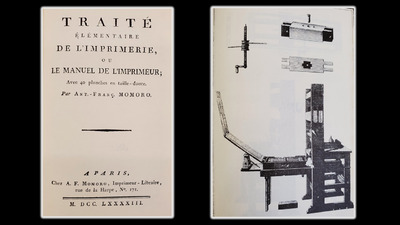 Traite elementaire de l'imprimerie
 Published in 1793 by Antoine Francis Momoro, an important French printer and typographer. Traite is a printer's manual that was highly regarded and quickly became a classic. This work bolstered Momoro's credentials and paved the way for him to become one of the best printers in the French capital. Traité élémentaire de l'imprimerie is one of the most important French manuals for printing and includes the history of printing (up to 1793), the different types and parts of the printing press, and the operations of printing. It was the first printer's manual to be arranged alphabetically as an encyclopedia. Traité also includes system of approbations and permissions governing publishing during the Ancien Régime as well as the economics of the printing trade in the revolutionary period. The plates within the volume beautifully illustrate the principle operations and tools of printing, constructional details of the press, as well as the tools and processes used during bookmaking. The 1793 volume is the rarer version of this edition as unsold sheets were re-issued in 1796 with a cancel title, which is the more common form.
Located in the Rare Books collection (RBX) {Z118.5.M666 1793a}
-
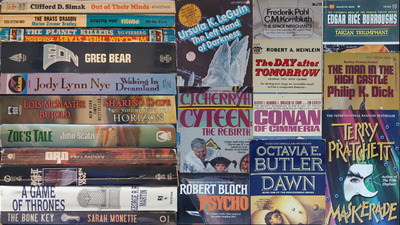 Science Fiction Collection
 The SFWA collection covers a broad spectrum of books in both the science fiction and fantasy realms. Emphasis has been given to books nominated for the Nebula Awards, a large portion of which has been donated by the Science Fiction and Fantasy Writers of America (SFWA) and its members until 2014. The collection also contains holdings of science fiction magazines (1920s-) and the SFWA archives, which includes papers of the organization as well as its Science Fiction and Fantasy author members.
Titles located in SFWA Collection
*Out of Their Minds by Clifford D. Simak {PS3537.I54 O98 1970a}
*Ace Double: The Brass Dragon by Marion Zimmer Bradley and Ipomoea by John Rackham {PR6068.A235 I76 1969a}
*Ace Double Novel Books: The Planet Killers by Robert Silverberg and We Claim These Stars! by Poul Anderson {PS3551.N378 W43 1959a}
*Eon by Greg Bear {PS3552.E157 E66 1985a}
*Waking in Dreamland by Jody Lynn Nye {PS3564.Y415 W35 1998a}
*The Sharing Knife. Volume four, Horizon by Lois McMaster Bujold {PS3552.U397 S57 2009a}
*Zoe's Tale by John Scalzi {PS3619.C256 Z44 2008a}
*Orn by Piers Anthony {PS3551.N73 O76 1971a}
*Night Shift by Stephen King and John MacDonald {PS3561.I483 N5 1979a}
*A Game of Thrones by George R.R. Martin {PS3563.A7239 G36 1996a}
*The Bone Key by Sarah Monette {PS3613.O5246 B66 2007a}
*The Left Hand of Darkness by Ursula K. LeGuin {PS3562.E42 L437 1976a}
*Cyteen: The Rebirth by C.J. Cherryh {PS3553.H358 C9871989A}
*Psycho by Robert Bloch {PS3503.L718 P71989A}
*The Space Merchants by Frederik Pohl and C.M. Kornbluth {PS3566.O36 S6 1969a}
*The Day After Tomorrow by Robert A. Heinlein {PS3515.E288 S55 1958a}
*Conan of Cimmeria by Robert E. Howard, L. Sprague De Camp, and Lin Carter {PS3515.O842 C63 1969a}
*Dawn by Octavia Butler {PS3552.U827 D38 1997a}
*Tarzan Triumphant by Edgar Rice Burroughs {PS3503.U687 T485 1964a}
*The Man in the High Castle by Philip K. Dick {PS3554.I3 M24 1974a}
*Maskerade by Terry Pratchett {PR6066.R34 M3 2000a}
-
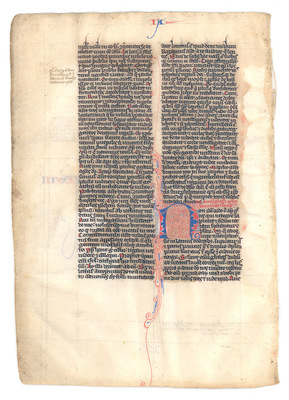 Bible, France, circa 1250 AD
 This small Latin Bible, which was produced in France in about 1250 A.D., measures approximately 4 inches across. Click the image on the left to see an enlarged view next to a ruler in order to better see its actual size. This leaf is from the book of Acts, Chapter XXVII- Chapter XXVIII and a preface to the Pauline Epistles. This particular item features some basic decorative initials, which show the reader the major divisions of the text. Typically, there was a hierarchy for the initials--the more important the text break, the fancier the initial. We see then, the most elaborate initial opening the Epistles. While in the early years of book production, the initials were added by the book's scribe, beginning in the thirteenth century, specialists would fill in the initials in the spaces left blank by the scribe. Red and blue were common colors -- these initials are often called "rubrication". In the fifteenth century, a preference for purple ink emerged. Because of its size, and the level of decoration, this was most likely a relatively inexpensive Bible when it was produced. This particular leaf has some staining, possibly from water damage.
-
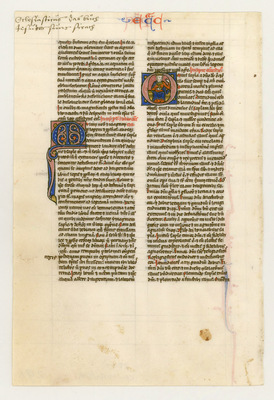 Bible, Paris
 This 13th century leaf, from a Latin Bible produced in Paris, is roughly contemporary to the the PREVIOUS PAGE SAY THIS CORRECTLY --but was likely slightly more expensive, since it is bigger, and features historiated (initials with pictures in them that usually relate to the text) and illuminated (decorated with gold or silver leaf) initials. This leaf has pen flourishing on the recto and the verso has an illuminated initial in the first column and a historiated initial depicting King Solomon (NOT AT ALL CLEAR) in the letter "O" in the second column. The passage is primarily drawn from the Book of Wisdom with the historiated initial opening of the book of Ecclesiasticus.
-
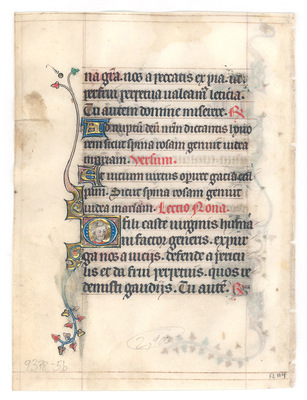 Book of Hours, Picardy, France, circa 1325 AD
 This example is from a Book of Hours from Picardy, France, possibly Amiens, from approximately 1325 A.D. It has two historiated initials and a total of five decorated initials.
Books of hours are worship books used by regular people (not members of the clergy), as devotional items, to help with their daily prayers. They were held in the hand, and the illustrations were admired; they were not really used for reading the text. The text itself includes the standard prayers and psalms that are to be recited during the 8 different "hours" of the canonical day.
Books of hours were the first "popular" books, owned in large numbers by ordinary people, not just scholars or monks. They were also highly prized status items, proving the wealth of their owners through the richness of their illustrations and bindings.
