-
 H.P. Lovecraft Collection
 American novelist, H.P. Lovecraft (1890-1937), is universally considered to be the father of modern horror. He is responsible for creating the nucleus of the "Cthulhu Mythos," a cycle of loosely-related stories that he (and other writers including Robert Bloch, August Derleth, Robert Howard, Clark Ashton Smith, and Brian Lumley) conceived that concerned the "Great Old Ones," beings from outer space who took up residence on Earth to cause havoc.
(https://www.imdb.com/name/nm0522454/bio?ref_=nm_ov_bio_sm)
Letters from the H.P. Lovecraft Collection
*Autographed letter to Robert Bloch 1937 { PS3523.O833 Z48 1937a}
*Autographed letter to Clark Ashton Smith 1932 {PS3523.O833 Z543}
-
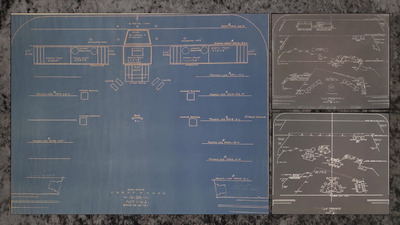 Historic Scenic Collection
 Historic Scenic Collection contains the scenes, costumes, maquettes, and other archival material of the Chicago Civic Opera and the Lyric Opera of Chicago. The archival materials date from 1865 to 2012, but predominately features the productions of the Chicago Civic Opera for the years of 1910 to 1931.
*Blueprint of Aida Act 1 Scene 2
*Floor Plan of La Traviata Act 1 Scene 1 "old"
*Floor Plan of La Traviata Act 1 Scene 1 [revised]
For more information and detailed holdings go to https://archives.lib.niu.edu/repositories/2/resources/111
-
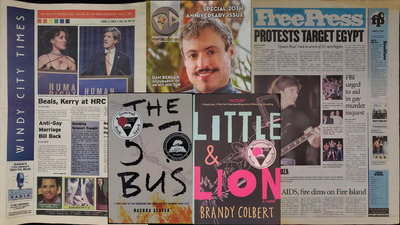 Gender Studies Collection
 The Gender Studies Collections consists of a growing collection of books and other published materials pertaining to gender studies, including gay, lesbian, transgendered, bisexual, queer, and women’s studies. Particular strengths of this collection are the publication history for the winners and nominees of the Stonewall Award and Midwest periodicals.
Items are located in the Gender Studies Collection
*Windy City Times { HQ75 .W562a}
*Positively Aware { RA644.A25 T82a}
*Chicago Free Press {HQ75 .C462a}
*The 57 Bus – 2018 Mike Morgan and Larry Romans Children’s and Young Adult Literature Award
*Little and Lion – 2018 Mike Morgan and Larry Romans Children’s and Young Adult Literature Award
-
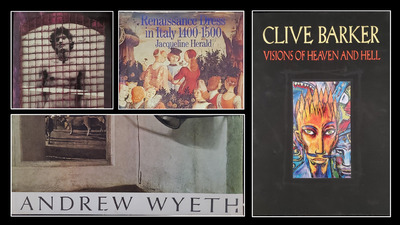 Fine Arts Collection
 The Fine Arts Collection encompasses works of various artists, mostly catalogues raisonnées, and other rare fine arts materials.
Items are located in the Fine Arts Collection
*Altars by Robert Mapplethorpe and Edmund White {TR654 .M33741995A}
*Renaissance Dress in Italy 1400-1500 {GT964 .H47 1981a}
*Andrew Wyeth {ND237.W93 M4}
*Clive Barker: Visions of Heaven and Hell {NX650.H67 B375 2005a}
-
 The Final Call
 "From humble beginnings in the basement of the Honorable Minister Louis Farrakhan’s south Chicago home in 1979."
Located at the African American Collection {BP221.A1 F542A}
-
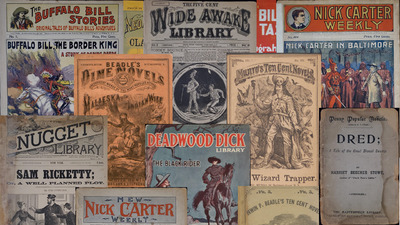 Dime Novel Collection
 Albert Johannsen Collection
and Edward LeBlanc Collection
The first dime novels were initially published around the start of the American Civil War, and became wildly popular in both the United States and in England, where they were known as "penny dreadfuls." Named for their cheap prices, dime novels were distributed in numerical series at newsstands and dry goods stores for a dime or a nickel a piece. The books were simple in appearance, bound in cheap paper with a brightly illustrated cover. They were lightweight at only about 100 pages long, easy to carry, and easy to pass around.
Irwin and Erasmus Beadle and Robert Adams published the first dime novel under their publishing house, Beadle and Adams, in 1860. It was a short novel entitled "Malaeska, the Indian Wife of the White Hunter," written by Mrs. Ann S. Stephens.
Irwin Beadle joined up with George Munro, a bookkeeper in the publishing house, and they founded their own house, Munro. Munro began to publish its own version of dime novels, calling them "Ten Cent Novels."
Another major publishing house for dime novels was Street and Smith. Authors like Horatio Alger, Upton Sinclair, and Jack London wrote for Street and Smith under pen names to make the money that would come with their published works.
Some of the most well-known dime novel writers were Thomas C. Harbaugh, Albert W. Aiken, Edward L. Wheeler, Joseph W. Badger, Jr., and Colonel Prentiss Ingraham. Ingraham was the most successful writer of the short novels as the creator of the famous character, Buffalo Bill.
(https://www.history.org.uk/student/resource/4512/american-dime-novels-1860-1915)
Dime novels are located in the Albert Johannsen collection and Edward LeBlanc collection by series title:
*The Buffalo Bill Stories No. 1
*Ned Buntline's Own Series No. 4
*The Five Cent Wide Awake Library Vol. 1 No. 11 (September 30, 1878)
*Buffalo Bill Border Stories No. 211 by Col. Prentiss Ingraham
*Nick Carter Weekly No. 304
*Beadle's Dime Novels No. 1 "Malaeska: the Indian Wife"
*Munro's Ten Cent Novels No. 171
*Nugget Library No. 83 (March 5, 1891)
*Deadwood Dick Library No. 2
*Penny Popular Novels: "Dred; A Tale fo the Great Dismal Swamp" by Harriet Beecher Stowe
*The New Nick Carter Weekly No. 27 (July 8, 1897)
*Irwin P. Beadle's Ten Cent Novels No. 5
-
 Comic Book Collection
 The Comic Book Collection consists of approximately 1,200 titles of comic books, graphic novels and trade editions, and trade magazines and fanzines. Much of our comic book collection dates from the 1970s forward, with particular strength in the 1990s.
Titles located in the Comic Book collection
*Aliens No. 1 of 6-Art by Mark Nelson, who taught at Northern Illinois University for twenty years. {PN6728 .A443 1988a}
*The Invincible Iron Man No. 6 (October 1968) {PN6728 .I76a}
*Captain America No. 101 (May 1968) { PN6728 .C35a}
*Sandman: Brief Lives {PN6728.s26 G35 1992a}
*Love and Rockets No. 1 {PN6728.L78a}
*Fables: Legends in Exile Book 1 (2002) {PN6727.W52 F33 2002a}
*Wonder Woman No. 210 (March 1974) {PN6728 .W65a}
-
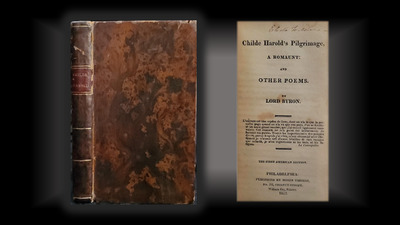 Lord Byron-Childe Harold's Pilgrimage
 George Gordon Byron, or Lord Byron (1788-1824): English Romantic poet.
The first two cantos of Childe Harold’s Pilgrimage were published by John Murray in 1812, and Byron “woke to find himself famous.” The poem describes the travels and reflections of a young man who, disillusioned with a life of pleasure and revelry, looks for distraction in foreign lands.
(https://www.britannica.com/biography/Lord-Byron-poet)
Lord Byron Collection:
Childe Harold's pilgrimage, a romaunt: and other poems. 1812-first American edition {PR4357 .A1 1812b}
-
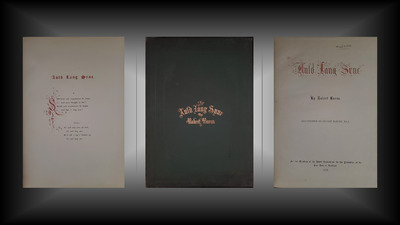 Robert Burns-Auld Lang Syne
 Robert Burns (1759-1796): Scottish poet.
In addition to poet, Burns found, edited, improved, and rewrote songs. It is by his songs that he is best known, and it is his songs that have carried his reputation round the world.
He never claimed “Auld Lang Syne,” which he described simply as an old fragment he had discovered, but the song we have is almost certainly his, though the chorus and probably the first stanza are old. (Burns wrote it for a simple and moving old air that is not the tune to which it is now sung, as George Thomson set it to another tune.)
(https://www.britannica.com/biography/Robert-Burns)
Robert Burns Collection:
This 1859 publication of Auld Lang Syne by Robert Burns is illustrated by George Harvey. {PR4306 .A71859}
-
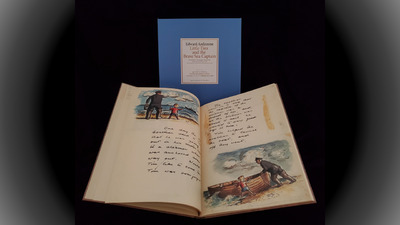 Edward Ardizzone-Little Tim and the Brave Sea Captain
 Edward Ardizzone (1900-1979): a noted contemporary English author and illustrator. He is often considered the father of the modern children’s picture book.
Between 1929 and his death in 1979, Ardizzone illustrated a large number of books, and wrote and illustrated many more including the well loved Little Tim series, Johnny the Clockmaker, Diana and her Rhinoceros, Paul the Hero of the Fire; and with his cousin Christianna Brand, created Nurse Matilda, later familiar to many as Nanny McPhee.
(https://www.ardizzoneprint.com/introduction-2/)
Edward Ardizzone Collection:
Little Tim and the brave sea captain : a facsimile of the original manuscript of the first edition of 1936 in the possession of the Victoria and Albert Museum, London. {PR6001.R445 L57 2011a}
