-
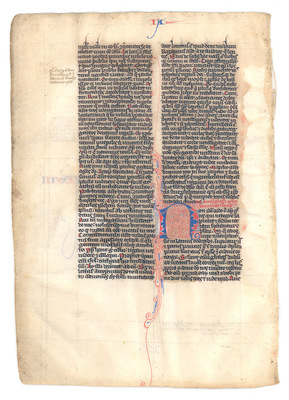 Bible, France, circa 1250 AD
 This small Latin Bible, which was produced in France in about 1250 A.D., measures approximately 4 inches across. Click the image on the left to see an enlarged view next to a ruler in order to better see its actual size. This leaf is from the book of Acts, Chapter XXVII- Chapter XXVIII and a preface to the Pauline Epistles. This particular item features some basic decorative initials, which show the reader the major divisions of the text. Typically, there was a hierarchy for the initials--the more important the text break, the fancier the initial. We see then, the most elaborate initial opening the Epistles. While in the early years of book production, the initials were added by the book's scribe, beginning in the thirteenth century, specialists would fill in the initials in the spaces left blank by the scribe. Red and blue were common colors -- these initials are often called "rubrication". In the fifteenth century, a preference for purple ink emerged. Because of its size, and the level of decoration, this was most likely a relatively inexpensive Bible when it was produced. This particular leaf has some staining, possibly from water damage.
-
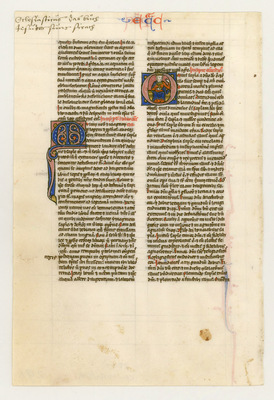 Bible, Paris
 This 13th century leaf, from a Latin Bible produced in Paris, is roughly contemporary to the the PREVIOUS PAGE SAY THIS CORRECTLY --but was likely slightly more expensive, since it is bigger, and features historiated (initials with pictures in them that usually relate to the text) and illuminated (decorated with gold or silver leaf) initials. This leaf has pen flourishing on the recto and the verso has an illuminated initial in the first column and a historiated initial depicting King Solomon (NOT AT ALL CLEAR) in the letter "O" in the second column. The passage is primarily drawn from the Book of Wisdom with the historiated initial opening of the book of Ecclesiasticus.
-
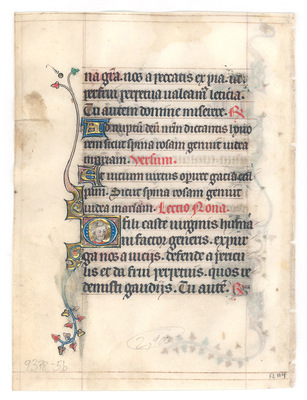 Book of Hours, Picardy, France, circa 1325 AD
 This example is from a Book of Hours from Picardy, France, possibly Amiens, from approximately 1325 A.D. It has two historiated initials and a total of five decorated initials.
Books of hours are worship books used by regular people (not members of the clergy), as devotional items, to help with their daily prayers. They were held in the hand, and the illustrations were admired; they were not really used for reading the text. The text itself includes the standard prayers and psalms that are to be recited during the 8 different "hours" of the canonical day.
Books of hours were the first "popular" books, owned in large numbers by ordinary people, not just scholars or monks. They were also highly prized status items, proving the wealth of their owners through the richness of their illustrations and bindings.
-
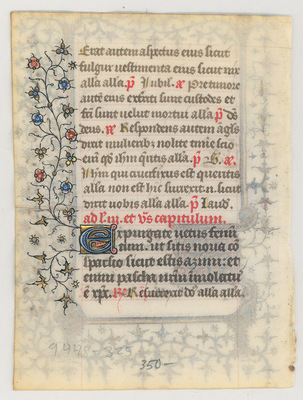 Breviary, circa 1400 A.D.
 A decorative leaf from a Breviary in Latin dating to around 1400 A.D. from Northern France is shown above. A breviary is a book of the daily Divine Office in the Catholic Church, used primarily by priests. It contains the texts used for funerals and saints' days, but not the Mass or Communion services. This example, given its minute size, was probably intended for lay use.
The large blank space above the text is unusual. It indicates that an illumination was planned but never executed.
-
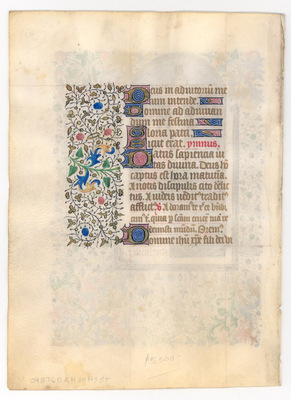 Book of Hours, Northern France, circa 1450 AD
 This image is of a full-page miniature painting of the Crucifixion from Northern France, from around 1450 A.D. This leaf was originally in a Book of Hours. The image marks the beginning of the Hours of the Cross.
-
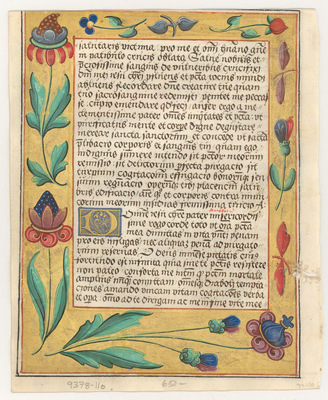 Psalter and Prayerbook, Northern Germany, circa 1524
 This leaf is from Northern Germany, possibly Hildesheim, from around 1524 and is from a Psalter and Prayerbook in Latin, with a gold leaf border. A Psalter is a book of Psalms, and could have been used by members of the clergy or lay people.
Three pages of same manuscript leaves at Cleveland Museum of Art.
Catalogue also describes this manuscript.
-
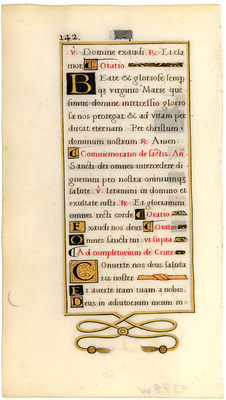 Book of Hours, France, circa 1530 AD
 This leaf is from a Book of Hours in Latin from France, possibly from the cities of Tours or Paris, from about 1530 A.D. This example has several decorated initials.
The design of this leaf is similar to two leaves offered for sale by Sotheby's in 2003, associated with "Dr. Myra Orth's so-called 1520s workshop." The most famous example of this workshop is the Doheny Hours, sold in 1998 by Sotheby's. The device of the knotted rope and the restrained colors used may indicate "that the patron was a member of the Cordelieres, the order of Franciscan Tertiaries to which the women of the French royal family belonged."
This leaf we have is not representative of the manuscript as a whole, some are highly illustrated and colorful, others are very plain.
-
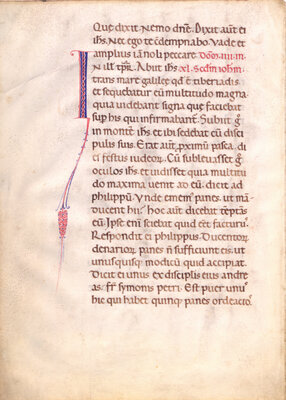 Gospel Lectionary, circa 1026 AD
 A LARGE LEAF FROM AN EARLY GOSPEL LECTIONARY. WITH TEXT FROM THE GOSPEL ACCORDING TO JOHN. (Italy, ca. 1150) 13 x 9 1/4". Single column, 22 lines, in an extremely fine late Carolingian hand. WITH A HANDSOME SIX-LINE DIVIDED INITIAL "I" in blue and red with a trailing penwork extension along the lower two-thirds of the leaf. Matted.
Just a hint of marginal soiling, but IN VERY FINE CONDITION, THE LOVELY SCRIPT PERFECTLY CLEAR, and the vellum bright and generally quite preserved.
